
Beyond the Meeting Room: Transforming Meetings from Time Consumers to Value Creators
A Process Excellence Perspective on Meeting Management
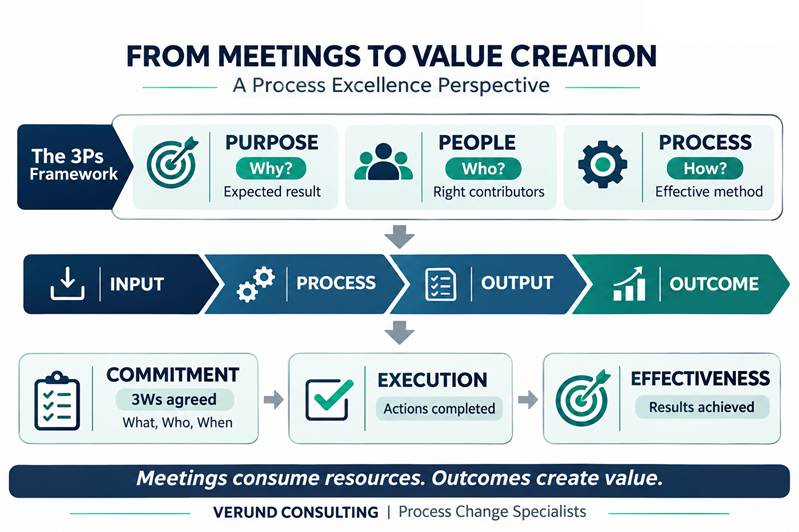
Introduction: The hidden factory of wasted time
Imagine a factory purchasing raw materials, consuming energy, deploying people, and operating machinery every day without knowing whether it is producing anything of value. Would management tolerate such a situation? Probably not. Yet, in many organizations, a similar phenomenon takes place every day in meeting rooms. People gather, opinions are exchanged, presentations are made, minutes are circulated and another meeting is scheduled. But what value has been created through this investment of organizational resources?
Perhaps the problem is not that organizations conduct too many meetings. It is that they conduct too many meetings without a clear understanding of what those meetings are meant to achieve.
1. The fundamental mindset shift: A meeting is a means, not an end
Conducting a meeting is not an accomplishment in itself. A production meeting is not successful merely because production was discussed. A quality meeting is not successful because defects were reviewed. A management meeting is not successful because all department heads attended.
A meeting is a mechanism through which people interact to achieve an expected outcome that requires their collective contribution. Three elements justify its existence: interaction, an expected outcome and interdependence.
When these elements are absent, question whether a meeting is the most appropriate mechanism. Information may be communicated through a report; an individual decision may be made by the person with appropriate authority; a simple issue may be resolved through direct communication. Not every management activity requires a meeting.
2. Meetings are not free: Understanding the hidden cost
Organizations carefully monitor material, labor, and energy costs. However, the cost of meetings often remains invisible. Consider two routine meetings in a hypothetical organization.
| Parameter | Weekly planning | Daily huddle |
| Participants | 9 | 10 |
| Duration | 60 minutes | 30 minutes |
| Hourly cost/person | LKR 500 | LKR 500 |
| Meetings/month | 4 | 24 |
| Monthly person-hours | 36 | 120 |
| Monthly staff time cost | LKR 18,000 | LKR 60,000 |
| Annual staff time cost | LKR 216,000 | LKR 720,000 |
These two meetings alone consume 1,872 person-hours and LKR 936,000 worth of staff time annually. This excludes preparation, follow-up, and opportunity costs. These illustrative staff time costs are not necessarily recoverable cash savings.
The objective is not necessarily to eliminate these meetings. They may generate value far exceeding their cost. The real question is: What value are we generating in return for this investment?
3. Meeting efficiency is not meeting effectiveness
| Efficiency | Effectiveness |
| Are we using resources wisely? | Are we achieving the intended outcome? |
| Right participants; minimum necessary time; adequate preparation; focused discussion | Purpose achieved; decisions made; actions implemented; intended results achieved |
A meeting that finishes in 15 minutes but resolves nothing may be time-efficient but ineffective. A two-hour problem-solving meeting that eliminates a recurring operational failure may be highly effective. An excellent meeting achieves its intended outcome with the minimum necessary consumption of resources.
4. The 3Ps of effective meetings
Purpose – Why are we meeting?
A topic describes what we intend to discuss. A purpose describes what we intend to achieve. A clearly defined purpose provides direction and a basis for evaluating success.
| Topic | Purpose |
| Production delays | Agree on a recovery plan for delayed orders |
| Quality issues | Agree on containment and investigation of recurring defects |
| Labour shortage | Finalize labour allocation for next week |
| Maintenance | Agree on maintenance priorities and equipment availability |
| Customer complaints | Determine immediate actions and investigation requirements |
People – Who is necessary, and why?
Select participants based on their contribution, rather than hierarchy, tradition, or convenience. Include those with the necessary information, expertise, decision authority, or implementation responsibility. Inviting unnecessary participants wastes resources; excluding essential participants compromises effectiveness.
Process – How will we achieve the purpose?
Define the required information, discussion sequence, time allocation, decision method, expected outputs, and follow-up. Purpose provides direction. People provide capability. Process converts that capability into results.
5. Viewing a meeting as a process
| Stage | Elements |
| Input | Facts, data, performance gaps, previous actions, issues, and risks |
| Process | Review, analysis, discussion, and decision-making |
| Output | Decisions, actions, owners, and deadlines |
| Outcome | Improved performance, resolved problems, reduced risks and better coordination |
An approved production plan is an output; improved plan adherence is the intended outcome. An agreed corrective action is an output; reduced defect recurrence is the intended outcome. An approved maintenance schedule is an output; improved equipment availability is the intended outcome.
Many organizations manage meeting outputs but fail to manage outcomes. They measure whether minutes were circulated and actions completed but rarely ask whether the intended improvement was achieved. The meeting room produces decisions. The workplace must produce results.
6. Applying Lean thinking: Seven wastes in meetings
| Waste | Typical manifestation |
| Unnecessary meetings | Simpler communication would suffice |
| Unnecessary participation | People who cannot meaningfully contribute |
| Waiting | Late arrivals, missing information, or decision-makers |
| Overprocessing | Excessive presentations and documentation |
| Repetition | Discussing the same unresolved issues repeatedly |
| Defective outputs | Ambiguous decisions, unclear actions, and missing deadlines |
| Underutilized talent | Failing to obtain contributions from knowledgeable participants |
These categories are a practical adaptation of Lean thinking, not the conventional seven manufacturing wastes. A meeting that consistently starts late, revisits unresolved issues, and concludes without accountability is a poorly designed and poorly controlled management process.
7. Standardized Work for meetings
Organizations develop Standardized Work for manufacturing, quality control, and maintenance. Why should meetings be an exception? Meeting management can be standardized through three phases.
Before the meeting – Preparation
Define purpose, identify participants, prepare a focused agenda, and ensure information is available.
Output: meeting readiness.
During the meeting – Execution
Clarify purpose, review facts, facilitate focused discussions, make decisions, and establish accountability.
Output: decisions and agreed actions.
After the meeting – Implementation
Communicate decisions, execute actions, verify completion, evaluate effectiveness, and escalate unresolved issues.
Output: implemented and verified actions.
The intended outcome is the improvement these actions produce in the workplace. Standardize common management disciplines while adapting the process to its purpose. Information sharing, decision-making, problem-solving, performance review, and planning meetings require different methods.
8. The 3W discipline: Converting discussion into action
WHAT – What action must be taken? WHO – Who is accountable? WHEN – By when must it be completed? Without these three elements, an agreed action remains an intention rather than an accountable commitment.
Mature meeting management goes beyond recording the 3Ws. There are three levels: commitment (action agreed), execution (action implemented), and effectiveness (intended result achieved).
An action can be completed without being effective. For example, conducting training to address a recurring quality problem may satisfy an agreed action. But if the defect continues, effectiveness has not been demonstrated. Closing an action is not necessarily the same as closing a problem.
9. From isolated meetings to an integrated meeting rhythm
Meetings should form an integrated management rhythm through which information flows, performance is reviewed, decisions are made and unresolved issues are escalated.
| Meeting rhythm | Primary purpose |
| Daily operational huddle | Manage immediate operational deviations |
| Weekly planning | Coordinate resources and finalize feasible plans |
| Fortnightly departmental review | Manage departmental performance gaps |
| Monthly management review | Review organizational performance and allocate resources |
| Quarterly strategic review | Evaluate strategic progress and priorities |
| Annual planning | Establish goals, budgets, and direction |
Determine frequency and duration based on organizational needs rather than habit. Resolve issues at the lowest appropriate level of authority. Escalate issues requiring resources, cross-functional coordination, or higher-level decisions. Management decisions and strategic direction must flow downwards into operational execution. This transforms meetings into the nervous system of the management system.
10. Stop reviewing reports. Start managing deviations.
The purpose of a performance review is not merely to become aware of performance. It is to manage performance. Exception-based meeting management focuses attention on significant deviations, emerging risks and decisions requiring collective intervention, while retaining mandatory control reviews.
- What is the deviation?
- What is its impact?
- What immediate intervention is required?
- Who is accountable?
- When will the issue be resolved or escalated?
Chronic problems requiring deeper investigation should be transferred to a structured problem-solving process rather than repeatedly debated during routine meetings. The meeting identifies the need for intervention. The problem-solving process delivers the solution.
11. Measuring meeting effectiveness
| Metric | Formula |
| Purpose achievement rate | Meetings achieving purpose / meetings conducted × 100 |
| On-time action closure rate | Actions due in period completed by due date / actions due in period × 100 |
| Meeting time adherence rate | Meetings within allocated time / meetings conducted × 100 |
| Action effectiveness rate | Actions due for verification in period verified effective / actions due for verification in period × 100 |
Time adherence measures efficiency. Purpose achievement and action effectiveness provide insights into effectiveness. On-time action closure measures execution discipline. Use these as diagnostic metrics to improve the system rather than automatically creating additional individual KPIs.
12. Developing organizational meeting capability
At Verund Consulting, we approach management capability development through three complementary dimensions: Mindset, Skillset and Toolset.
Mindset – Understand why meetings consume resources and must create value.
Skillset – Develop the ability to define purposes, facilitate discussions, listen actively, challenge assumptions, make decisions and establish accountability.
Toolset – Establish meeting charters, structured agendas, Standardized Work, 3W action registers and meeting calendars.
Mindset without skillset creates awareness without capability. Skillset without toolset creates capability without consistency. Toolset without mindset creates compliance without commitment. Sustainable improvement requires all three.
Conclusion: From discussions to decisions, actions, and results
The objective is not simply to conduct fewer, shorter, or more disciplined meetings. It is to create a management system in which collective time, knowledge and expertise are systematically converted into organizational value. Before calling your next meeting, ask whether it is necessary, what outcome it must achieve, who is essential, what process will deliver it and how value will be verified.
The success of a meeting is not determined by the quality of the discussion alone, but by the value created through its outcomes.
#MeetingManagement #ProcessExcellence #LeanManagement #OperationalExcellence #ManagementEffectiveness #LeadershipDevelopment #ContinuousImprovement #VerundConsulting