
Chronic Problem Hacker: Stop Solving Problems. Start Eliminating Their Creation.
Introduction: The Lie We Tell Ourselves About Problems
In most organizations, problems are treated as isolated events. A defect occurs, a delay happens, a complaint arises — and teams rush to fix it. The issue disappears… temporarily.
Then it comes back.
Different shift. Different operators. Same problem.
This is not coincidence. It is not bad luck. It is not even human error.
It is the system.
Chronic problems do not survive because they are difficult to solve. They survive because they are recreated — continuously — the system is designed and operated.
This is where the Verund’s Chronic Problem Hacker comes in.
The Uncomfortable Truth
Most organizations believe they are solving problems.
They are not. Why ?
They are solving symptoms — while the system quietly recreates the problem again.
Different shifts. Different person. Same issue.
This is not failure of effort. It is failure of management thinking.
“Problems do not repeat. Systems do.”
Why Conventional Problem-Solving Fails
Traditional approaches — including 8 steps problem solving — often fail in practice.
Not because they are wrong, but because of the way they are applied.
– Follow a single causal path
– Stop at visible causes
– Drift into vague language
– Default to blaming people
The result: temporary fixes, permanent recurrence.
What is a Chronic Problem Hacker?
A Chronic Problem Hacker is not a tool. It is a way of thinking. It is designed by using Verund’s years of experience in solving all four types of problems in different industries and in different manufacturing systems.
It shifts the focus from:
– fixing problems → to understanding how problems are created
– blaming people → to examining system conditions
– solving events → to eliminating recurrence
It is designed specifically for chronic problems — problems that keep coming back despite repeated fixes.
The Core Model: Where Problems Are Created
The model reveals a critical insight:
Problems are not created at the surface. They are constructed layer by layer. Most of the time problem solvers stop at either level one or two and assume that the problem gets solved. The reality is quite different.
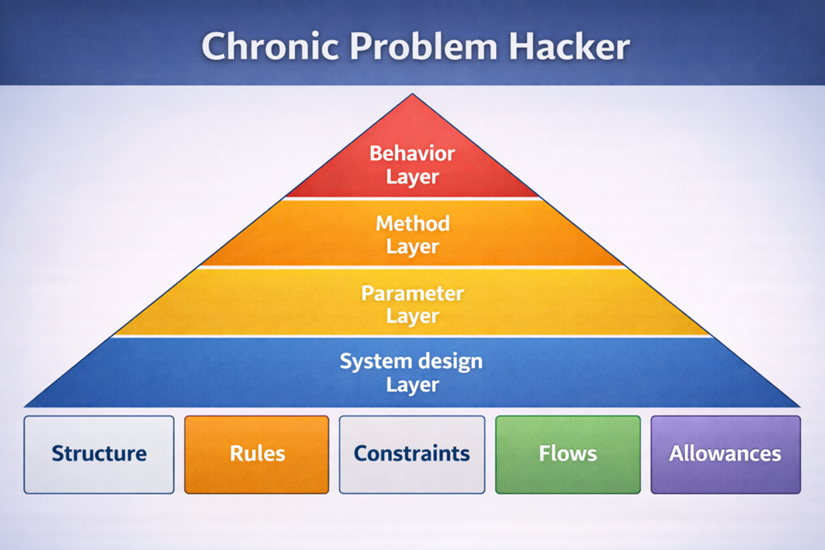
At the top, we see behavior — actions taken or not taken.
Below that lies method — how work is structured.
Then parameters — the boundaries that define normal vs abnormal.
And at the foundation, system design — the deepest level where problems are truly created.
System design itself is shaped by:
– Structure (who owns what)
– Rules (how decisions are made)
– Constraints (what limits action)
– Flows (how information and materials move)
– Allowances (what deviation is tolerated)
A chronic problem survives because something in these layers keeps recreating it.
5 Why vs Chronic Problem Hacker
5 Why asks: Why did this happen?
Chronic Problem Hacker asks: How is the system creating this repeatedly?
5 Why digs deeper. Chronic Problem Hacker digs deeper AND locates where the problem is being constructed.
This is the difference between solving and eliminating.
The 5-Step Causal Drill
WHAT changed?
WHAT exactly failed?
WHY here?
WHY allowed?
WHY repeated?
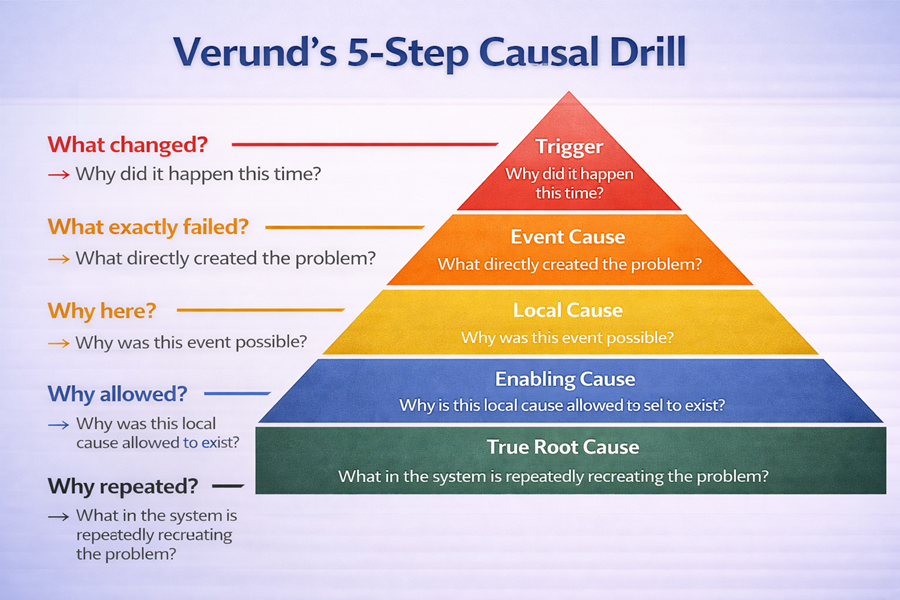
Each question forces a shift deeper into the system — from symptom to creator.
Example: A Problem That Refuses to Die
A recurring defect appears in production.
What changed? → New material batch
What failed? → Seal integrity
Why here? → Temperature drops at process point
Why allowed? → No real-time monitoring
Why repeated? → System designed for delayed detection
This is not an operator issue. This is a system design issue.
And unless the system design changes — the problem will return.
The Shift That Changes Everything
Chronic Problem Hacker replaces one fundamental question:
From: Who caused this?
To: What made this inevitable?
This shift removes blame and exposes system truth.
“You do not eliminate problems by fixing them. You eliminate them by stopping their creation.”
Conclusion: Eliminate the Creator, Not the Symptom
Chronic problems are not stubborn. Systems are.
If the system remains unchanged, the problem will return — in a different form, through a different person, at a different time.
The only way to eliminate a problem permanently is to eliminate the mechanism that keeps creating it.
That is the essence of the Chronic Problem Hacker.
It does not solve problems. It stops them from being created.