
Event Problems vs Condition Problems: Understanding How Problems Emerge in Systems
Introduction
In operational environments, organizations often react quickly when failures occur — machines break down, quality defects appear, production stops, or customers complain. These are highly visible disturbances that demand immediate attention. However, effective problem solving requires a deeper understanding of how problems actually emerge within systems.
A powerful way to understand operational failures is to distinguish between two fundamental types of problems: Event Problems and Condition Problems. This distinction is not about severity or frequency. Instead, it is based on how the problem exists in time.
Recognizing this difference helps managers move from reactive firefighting toward systemic improvement.
How Problems Exist in Time
The most important distinction between event problems and condition problems is how they appear in time.
Event problems occupy a point in time.
Condition problems occupy a span of time.
This distinction can be visualized through a simple timeline model.
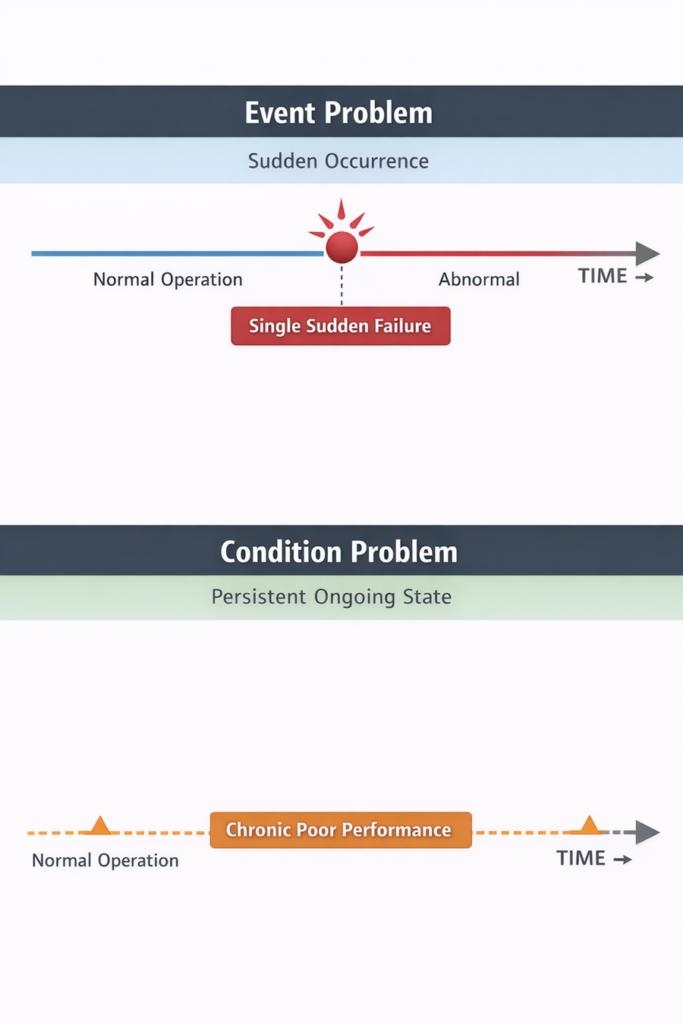
Event Problems
An event problem occurs at a specific moment in time. The system was operating normally until a disturbance caused a sudden deviation. Because they occur at a point in time, event problems usually trigger urgent reactions from managers.
Examples include:
– Machine breakdown
– Conveyor belt failure
– Sudden temperature spike in a process
– Product contamination detected in a batch
In event problems, the key investigative question is: What changed before this happened?
Condition Problems
A condition problem is different. Instead of occurring at a specific moment, it exists continuously over a period of time. The system operates in a persistent undesirable state.
Examples include:
– OEE remaining at 55% for months
– Chronic rework in a production process
– Excess inventory in the system
– Long changeover times that are treated as normal
In condition problems, the key question changes from ‘What happened?’ to ‘Why are we operating like this?’
The Four Types of Problems
To deepen this understanding, problems can be further classified based on visibility. When we combine time pattern (Event vs Condition) with observability (Visible vs Invisible), four types of problems emerge.
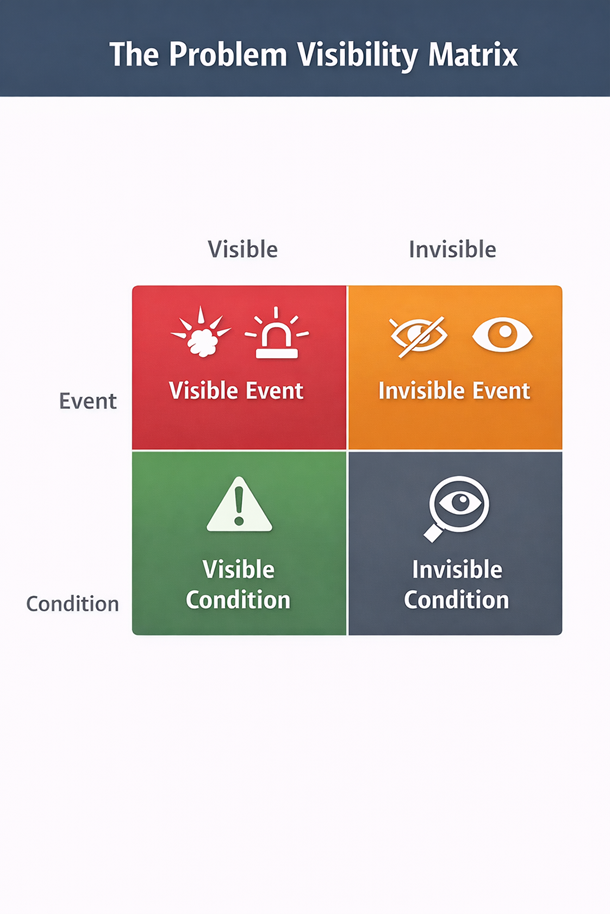
These four categories are:
– Visible Event
– Invisible Event
– Visible Condition
– Invisible Condition
Visible events are the failures organizations usually react to. Invisible conditions are the hidden weaknesses that create those failures.
How Problems Emerge in Systems
Most operational failures follow a chain of emergence. Problems rarely appear suddenly without prior signals. Instead, they evolve from underlying conditions within the system.
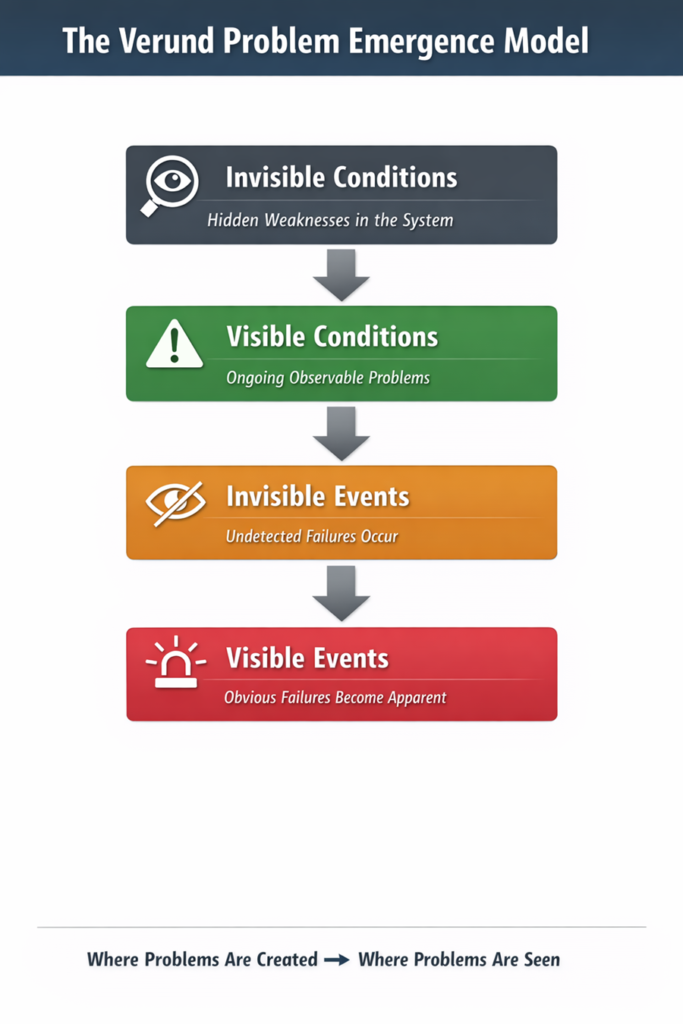
This model highlights a critical insight: organizations often respond only to visible events, while the real causes exist in invisible conditions.
Key Insights for Managers
Several powerful principles emerge from this framework:
Events interrupt the system. Conditions define the system.
Events reveal problems. Conditions create problems.
Events are signals. Conditions are sources.
Therefore, when an event occurs, managers should always ask: What condition allowed this event to happen?
Conclusion
Effective problem solving requires looking beyond visible failures. Event problems are often only the symptoms of deeper condition problems embedded within the system.
Organizations that focus only on fixing events remain trapped in reactive firefighting. Organizations that investigate conditions build stronger, more reliable systems.
Understanding the distinction between events and conditions is therefore not just a conceptual exercise — it is a foundational capability for operational excellence.