
Why Most Root Cause Analysis (RCA) Fails
Using the Iceberg Model of Systems Thinking to Go Beyond 5-Why
Introduction
“We did the RCA… but the problem came back.”
This is one of the most common frustrations we hear from managers, engineers, and senior leaders across industries.
- The team conducted a Root Cause Analysis
- 5-Why was applied
- Action plans were created.
- Countermeasures were implemented.
Yet, the same problem reappears—sometimes within weeks, sometimes in a different form.
The issue is not that teams are careless or incapable.
The issue is that most Root Cause Analysis (RCA) stops too early.
To understand why, we need to look at RCA through the Iceberg Model of Systems Thinking.
The Iceberg Model: Seeing What RCA Usually Misses
The Iceberg Model explains that visible problems are only a small part of a deeper system.
The four levels of the Iceberg
- Events – What just happened.
- Patterns – What keeps happening over time.
- Structures – Systems, processes, KPIs, policies, roles
- Mental Models – Beliefs, assumptions, mindsets that design the system.
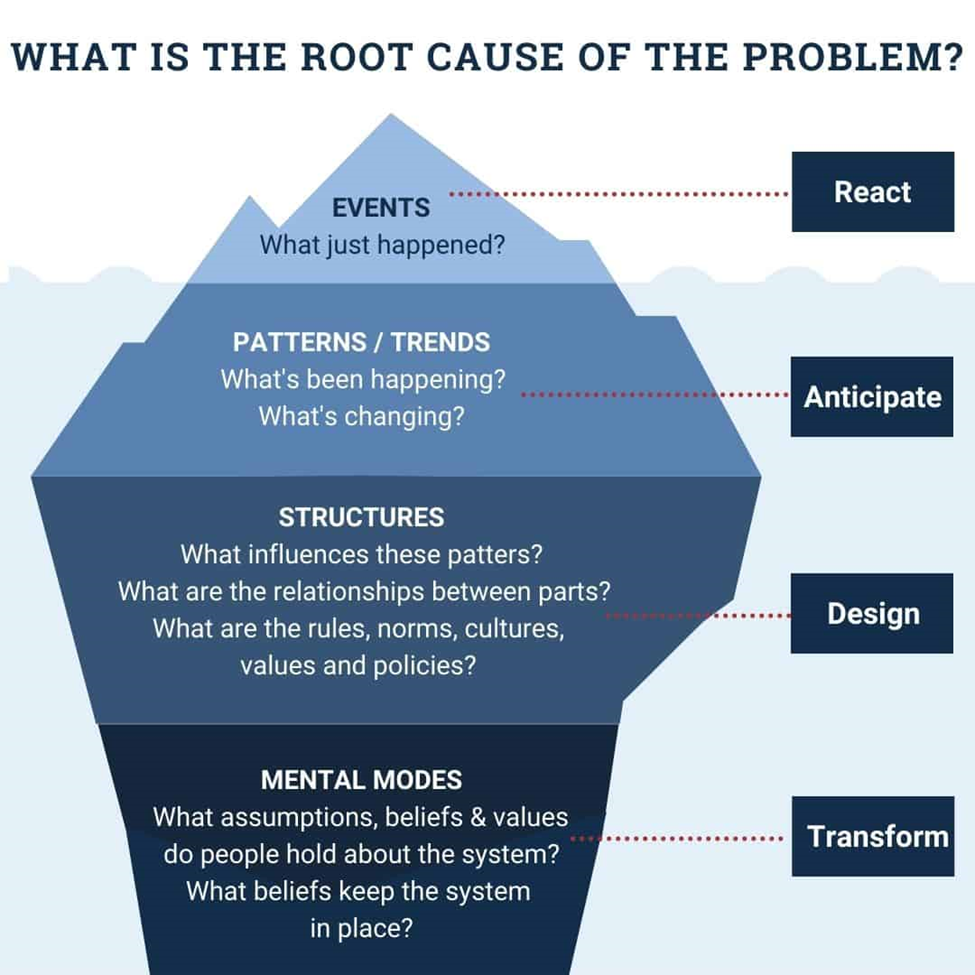
Most organizations perform RCA only up to Level 3 (Structures).
Very few go to Level 4 (Mental Models)and that is where most real root causes live.
Where the 5-Why Technique Usually Stops
The 5-Why technique is powerful—but only if used deeply.
In practice, we see this pattern repeatedly:
| RCA Level | Typical 5-Why Outcome |
| Event | Operator made a mistake |
| Pattern | Rework happens frequently |
| Structure | SOP not followed / training gap |
| Mental Model | ❌ Not explored |
The RCA concludes with:
- “Revise SOP”
- “Conduct training”
- “Increase supervision”
These are structural countermeasures, not systemic ones.
Why Structural RCA Is Not Enough
Structures do not exist by accident.
They are created and sustained by mental models of leaders.
If those mental models remain untouched:
- SOPs are ignored again.
- Training fades into routine
- Supervision becomes firefighting.
The problem is solved, but the system quietly recreates it.
Connecting Iceberg Model with 5-Why (The Missing Link)
The real power of RCA emerges when 5-Why is consciously extended through all four Iceberg levels.
A better question is not:
“Why did this happen?”
But:
“At which level of the Iceberg did we stop asking why?”
Practical Example 1: Repeated Quality Defects
Event
Finished products fail final inspection.
Pattern
Defects spike every time production volume increases.
Structure (Typical RCA stop point)
- Operators skip checks.
- Inspection SOP not followed.
Common countermeasures:
- Retrain operators.
- Add inspectors.
Mental Model (Usually ignored)
- “Inspection slows production.”
- “Quality is QC’s responsibility”
- “Meeting the plan matters more than first time right.”
True root cause:
Leadership belief system rewards output over quality.
Effective countermeasure:
- Redefine leadership KPIs.
- Shift belief from inspection detects defects to process prevents defects.
- Leaders model quality-first decisions
Practical Example 2: Chronic Firefighting by Managers
Event
Managers constantly chase urgent issues.
Pattern
No time for improvement or people development.
Structure
- No standard daily management
- No time blocked for improvement work
Common countermeasures:
- Time management training
- More meetings
Possible Mental Model
- “A good manager solves problems personally.”
- “Delegation means loss of control.”
- “Improvement work is extra work.”
True root cause:
Managerial identity tied to heroics, not system building.
Effective countermeasure:
- Redefine manager’s role.
- Shift belief from doing to developing people and processes.
Practical Example 3: ERP Implementation Struggles
Event
ERP data is inaccurate.
Pattern
Users delay or avoid data entry.
Structure
- No clear data ownership
- Poor system training
Common countermeasures:
- More training
- More controls
Possible Mental Model
- “ERP is an IT system”
- “Data entry is clerical work.”
- “My real job is operations, not systems.”
True root cause:
Leadership has not positioned ERP as a management system, only software.
Why Leaders Rarely Like Level 4 RCA
Going to mental models is uncomfortable because it:
- Questions long-held assumptions
- Surfaces leadership beliefs
- Challenges “the way we have always done things.”
That is why many RCAs unconsciously stop at structures.
But avoiding mental models means:
We fix symptoms while preserving the system that creates them.
A Practical Iceberg-Based RCA Discipline
When facilitating RCA, enforce these four questions in sequence:
- What happened? (Event)
- Where have we seen this before? (Pattern)
- What in our system allows this to happen? (Structure)
- What belief or assumption designed this system? (Mental Model)
If RCA ends before Question 4, it is incomplete.
How Countermeasures Change When Mental Models Are Addressed
| RCA Level | Countermeasure Type |
| Event | Fix, firefight |
| Pattern | Controls, monitoring |
| Structure | SOPs, KPIs, roles |
| Mental Model | Leadership behavior, decision logic, governance |
Only Level 4 countermeasures create lasting change.
Conclusion:
RCA is not about tools—it is about courage.
The Iceberg Model does not replace 5-Why.
It completes it.
Most organizational problems persist, not because:
- People are incompetent.
- Processes are weak.
But because:
Unexamined mental models silently recreate the same structures repeatedly.
Effective Root Cause Analysis requires the courage to look below the waterline—into leadership beliefs, assumptions, and decision logic.
“A problem is not solved until the thinking that created it is addressed.